

Happy Movie Monday! I am happy to be back after a little break. Life has been busy, but fortunately for me (and unfortunately for my wallet), I finally have time again to go to the movie theater routinely!
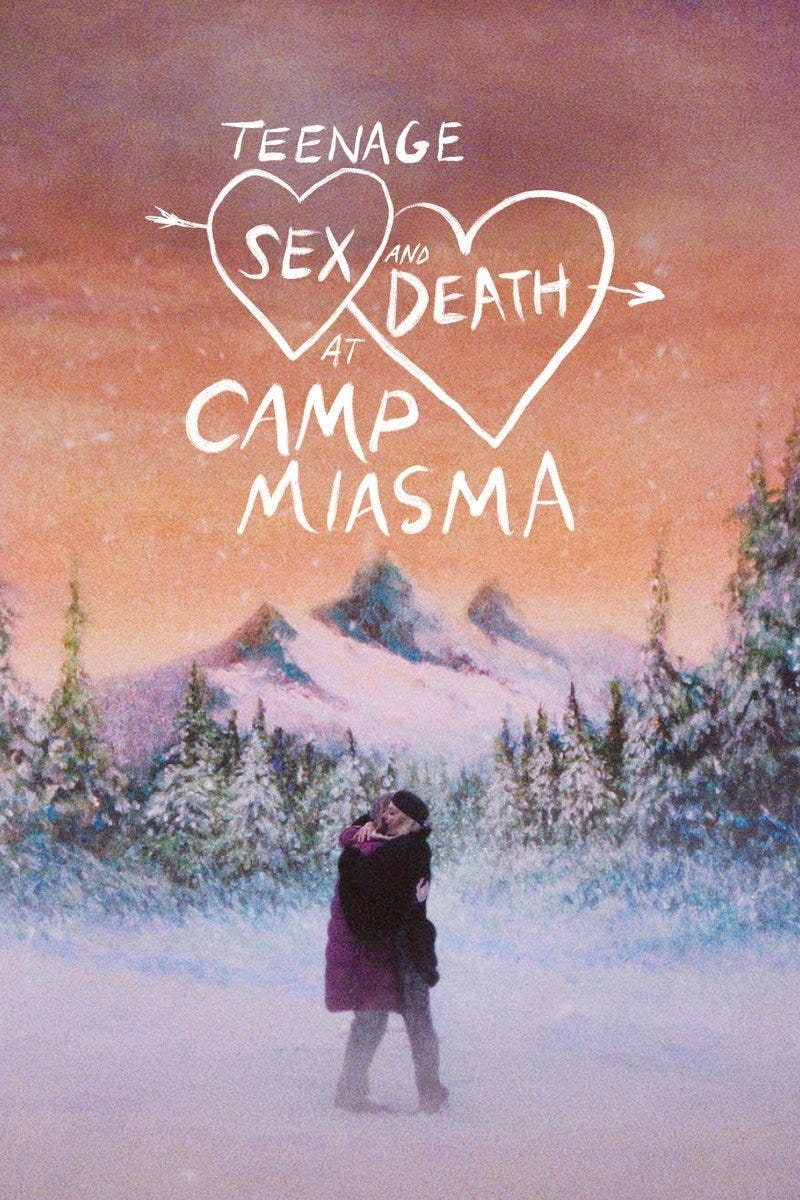
This weekend, I saw a movie that I was greatly anticipating: Jane Schoenbrun’s new film, Teenage Sex and Death at Camp Miasma. I was excited for this film for many reasons. Schoenbrun is, in my opinion, one of the best working directors of a newer generation. At a time when so much of the film industry feels trite, Schoenbrun brings an original, deeply intelligent, and unapologetically queer voice to their movies. The state of the industry is something Schoenbrun directly parodies in this film, as a major plot point of Camp Miasma is the easy money to be made in remaking existing IP.
The movie centers on Kris (Hannah Einbinder), a young queer director who is brought on to revitalize an old, problematic IP: an ’80s cult classic slasher series titled Camp Miasma. She is brought on specifically to “wokeify” the IP, by creating an origin film based on the series’ problematic villain, “Little Death.”
“Little Death” is the ghost of a kid who was drowned at the fictional Camp Miasma for being genderqueer, which the movie frames as horrifying. He periodically rises from the depths of the lake to take revenge on the camp, slaughtering anyone he finds with a large, rusty spear. The character is a satirical take on the trans-coded villains of classic horror, such as Psycho’s Norman Bates or Buffalo Bill in The Silence of the Lambs.
In an attempt to revitalize the failing franchise, Kris travels to rural Washington to visit Billy Presley (Gillian Anderson), the actress who played the original “final girl” in the first Camp Miasma. Billy refused to appear in any of the subsequent films and eventually abandoned acting entirely. Kris, who relates her sexual awakening to a scene from the original movie, is convinced that Billy is exactly what the series needs. She is immediately captivated by the elegant and somewhat off-putting woman, who now lives in seclusion at the abandoned campground where the first movie was filmed, surrounded by “Little Death” memorabilia.
This setup sounds like the perfect formula for a horror movie: a young woman enters a secluded location to meet a mysterious, potentially unstable actress who has spent 40+ years obsessed with the horror film she once starred in. Surely, this is the beginning of a disaster!
But, it isn’t.
Instead, it becomes the beginning of a vulnerable, oddly wholesome love story. Kris and Billy bond over Camp Miasma and their complicated relationships with sex. As Kris learns about Billy’s own sexual awakening during the filming of the movie, the two begin to fall in love, finding a safe space within their shared fantasies.
Teenage Sex and Death at Camp Miasma is a lot of things, which makes it very difficult to summarize. It is psychological, scary, funny, romantic, perverted, wholesome, beautiful, and bloody. At its core, as Billy aptly puts it towards the beginning of the film, it is about “flesh and fluids.”
The movie explores the intertwined planes of sex and violence, offering a parodic analysis of sexuality and gender in classic horror films. It is simultaneously a love letter to those movies and an indictment of them—particularly of the ways media can affect how we see and experience the world.
What I found most impressive is how Schoenbrun manages to balance all of these seemingly contradictory tones. The movie can be genuinely frightening one moment and surprisingly tender the next, without either side feeling out of place.
At its heart, the film feels like a reclamation of female sexuality in horror: fetishized victimhood is transformed into consensual intimacy. The climax of the movie is an actual climax, but it doesn’t feel awkward to watch. It isn’t just some hollow sexy scene. Instead, it becomes a kind of “coming of age” (cumming of age?) moment, as Kris feels comfortable in her body for the first time in her life.
Camp Miasma is not only thematically rich, but also an incredibly beautiful and stylish film.
Even before the more abstract final act, the visuals throughout are dreamy, just a step away from reality. The film uses beautifully painted backgrounds in many scenes, interspersed with more realistic sets, creating the effect of constantly moving in and out of a dream.
The colors are vibrant: soft pinks, deep dark blues, and bright bloody reds splash across the screen. It is an extremely cathartic experience for anyone sick of the bland filters slapped onto everything nowadays!
The visual style perfectly complements the movie’s themes. Camp Miasma exists somewhere between fantasy and reality, just as its characters exist between their actual lives and the fantasies created by the media that shaped them.
The performances were amazing as well, with Einbinder and Anderson absolutely magnetic in their roles.
Hannah Einbinder brings a sincere naivety and awkwardness to Kris, while her amazing comedic sense provides levity to an otherwise thematically dense film. Her performance makes Kris feel both funny and vulnerable, allowing the character’s journey toward self-acceptance to feel genuine.
Gillian Anderson, as always, is deeply enthralling. She is funny, off-putting, sexy, and elegant all at once—deepening my already existing celebrity crush on her.
Teenage Sex and Death at Camp Miasma feels, in my opinion, like the final film in a trilogy of Schoenbrun’s existing work, its predecessors being We’re All Going to the World’s Fair (2021) and I Saw the TV Glow (2024).
While these movies are all very different, they share similar themes: gender and sexuality, self-discovery, and, most strongly, the ways in which screens and media influence us deeply. They influence how we see ourselves and how we interact with others, eventually becoming tied to intimate parts of our sense of self.
In World’s Fair, that influence is the internet. In TV Glow, it’s television. And finally, in Camp Miasma, it’s movies.
Schoenbrun’s movies seem increasingly concerned with the relationship between media and identity. The movies we watch, the screens we stare at, and the fictional worlds we immerse ourselves in can become inseparable from the way we understand ourselves.
These are themes that I believe will become even more prolific with time, as we begin to grapple with the effects that screens and technology have on the development of younger generations.
Ultimately, Teenage Sex and Death at Camp Miasma is exactly the kind of movie I want to see more of: strange, original, deeply queer, visually ambitious, and completely unwilling to fit neatly into one genre.
It is a horror movie, a romance, a comedy, a parody, a love letter to classic horror, and a critique of the very media it celebrates. More than anything, it is a movie about the ways that the stories we consume become part of who we are—and how we might reclaim those stories for ourselves.
Final Review: 5/5